

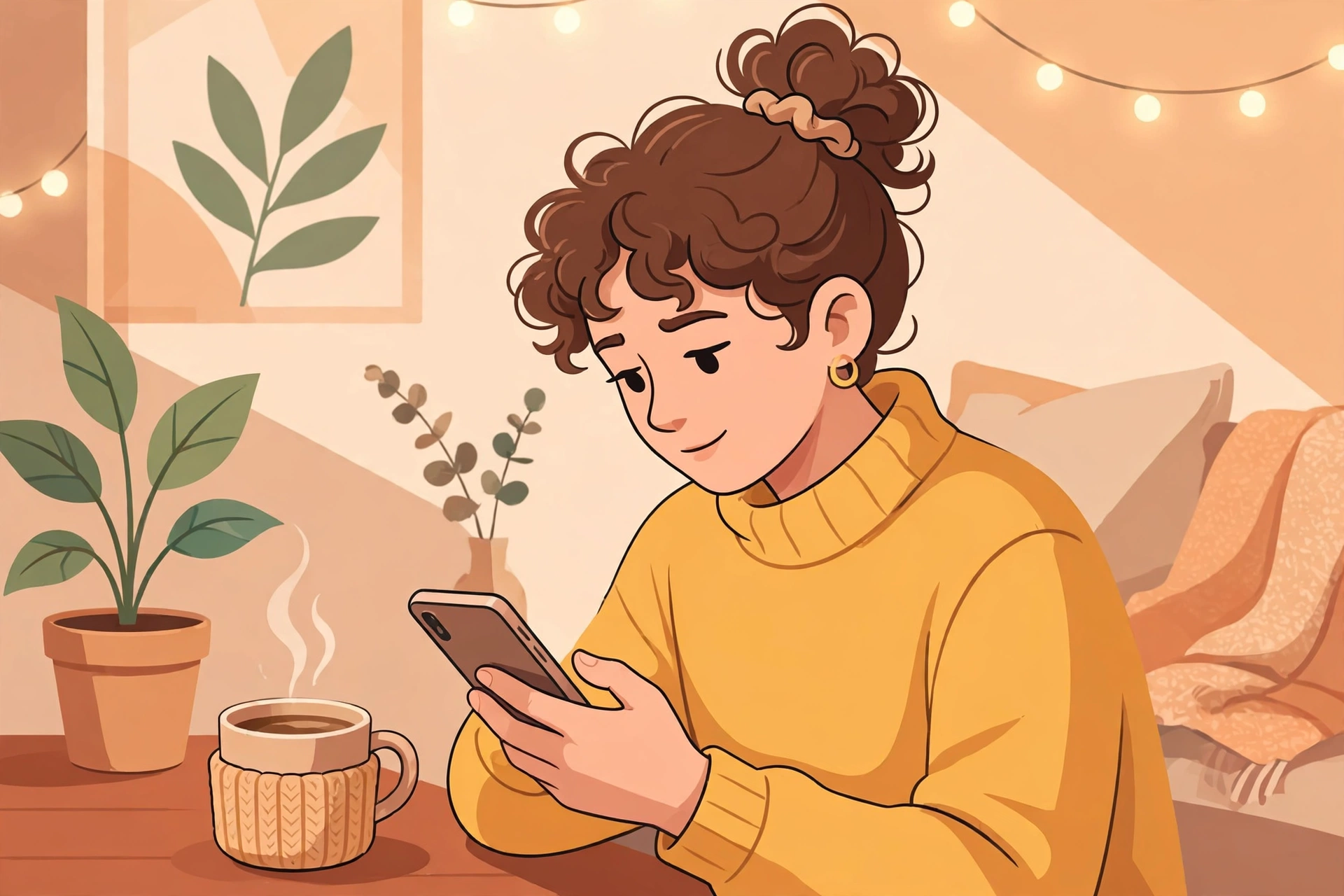
Starting a text conversation with a girl you like — or just want to get to know better — can feel awkward. The fear is usually the same: “What if I come across as creepy, boring, or pushy?”
The answer is simpler than most advice makes it sound: be respectful, be specific, give her an easy way to reply, and respect her response — including a slow reply or no reply.
This guide covers when it is appropriate to text, how to write a good first message, example openers (invented examples, not real chats), how to keep the first few exchanges going, and what not to do. It is written for situations where you already have a legitimate reason to text — you met somewhere, you have mutual friends, you are in the same class or group, or she gave you her number. It is not a guide to messaging strangers who have not given you their contact.
For keeping the conversation going after the first exchange, see how to keep a conversation going over text with a girl. For the counterpart perspective, see how to keep a conversation going over text with a guy.

About this article: use these openers as a starting point — keep it brief, be yourself, and respect a short or missing reply.
How This Article Was Put Together
This guide was built from openers people commonly use to start a text conversation respectfully — simple, relevant messages that invite a reply without pressure. We organized it by situation: first messages, replying to stories or posts, following up, and keeping it going. Each example was checked for clarity, kept respectful and low-pressure, and focused on practical wording you can adapt. Written by the 101Thing team and reviewed for clarity and safety.
About This Article
This article is part of the 101 Thing library of practical lists and guides, and it focuses on how to Start a Conversation With a Girl Over Text — 101Thing Guide. Its sections — including “First: Is It Appropriate to Text Her?” and “The First Message: What Works” — are organised so you can jump straight to the part that matches your situation and use it right away. Treat everything here as a starting point rather than a script: adapt the wording to your own voice, skip anything that does not fit, and put your own experience ahead of any list. We update our articles when we find errors or a better approach, and readers are welcome to suggest corrections through our contact page. For more on how we research and check the content we publish, see our Editorial Policy.
First: Is It Appropriate to Text Her?
Before you send anything, ask yourself three questions:
- Do I have a legitimate reason to have her number? Did she give it to you, did you meet in a shared context (class, work, event, mutual friends), or did you connect on a platform where messaging is expected?
- Would she expect a message from me? If you exchanged numbers after a conversation, yes. If you found her number from somewhere else without her knowledge, no — do not text.
- Am I okay with any answer, including no answer? If you can only accept an enthusiastic reply, you are putting too much pressure on one message.
If you got her number from a friend without her permission, do not use it. Ask the friend to introduce you instead, or wait until you have a natural chance to talk in person. Respect matters more than cleverness.
The First Message: What Works
A good first text has four qualities:
- Identifies you. She may not have your number saved. Say who you are and where you met.
- Is specific. Reference something real, not a generic “Hey”.
- Is light and low-pressure. You are starting a conversation, not confessing feelings.
- Ends with an easy question. Give her something simple to answer.
A useful structure: Hi + Who you are + Specific detail + Easy question.
Example structure (adapt the details):
“Hey, it’s Maya from the photography workshop — I was the one who kept asking about film cameras. I saw you posted about the exhibition — did you end up going?”
That works because it reminds her who you are, shows you were paying attention, and asks something she can answer in a sentence or two.
Example First Messages (Invented Examples)
These are templates to adapt. Change names, details, and context to fit your real situation. Do not copy them word-for-word if the details do not match — generic copy-paste messages are easy to spot.
If you met in a class, group, or at work
“Hi, it’s Jordan from Tuesday’s study group — I wanted to say thanks for explaining the last problem, that finally clicked. Are you going to next week’s session?”
Why it works: It is grateful, specific, and low-pressure. It also gives her a natural next step.
If you met at an event or through friends
“Hey, it’s Alex — we met at Sam’s dinner on Saturday. I really enjoyed our chat about travel. Have you been to that market you mentioned?”
Why it works: It places you in context, references a real conversation, and asks a follow-up.
If she shared something (a book, show, hobby, recommendation)
“Hi, it’s Priya — we talked at the book club about mystery novels. I finally started the one you recommended. First chapter is great — did you finish it?”
Why it works: It shows you listened and acted on what she said. That stands out.
If you connected on a dating app and moved to text
“Hey, it’s Daniel from the app — I enjoyed our chat about hiking. You mentioned a trail near the lake — is that the one you’d recommend for a beginner?”
Why it works: It continues the existing conversation instead of restarting with “Hey”.
If you have not talked in a while and want to reconnect
“Hi, it’s Sam — we met at the workshop last month. I just saw the photos from the event and thought of you. Hope you’ve been well!”
Why it works: It is honest about the gap, low-pressure, and does not demand a reply.
What NOT to Send as a First Message
Avoid these, especially as a first text:
- Just “Hey” / “Hi” / “What’s up?” — Puts all the work on her and gives her nothing to respond to.
- Appearance-only compliments — “You’re so beautiful” or “You’re hot” as an opener is likely to feel uncomfortable, especially from someone she barely knows. Compliment choices, interests, or ideas instead — or skip compliments entirely in the first message.
- Overly personal or suggestive messages — Anything sexual, overly intimate, or focused on her body is not appropriate as an opener.
- Long confessions — A paragraph about how you have been thinking about her, how nervous you are, or how much you like her puts heavy pressure on a first reply.
- Demanding messages — “Why haven’t you replied?” or “Are you ignoring me?” are not appropriate, especially if you just met.
- Multiple messages in a row — One first message is enough. Do not send “Hey”, “Hello?”, “Are you there?” in sequence.
- Copy-paste pickup lines — They signal low effort and often feel disrespectful.
A good test: if you would feel uncomfortable receiving this message from someone you barely know, do not send it.
After She Replies: The First Few Exchanges
Getting a reply is only the start. The next few messages set the tone.
1. Match her energy — roughly
If she sends a short, friendly reply, reply in a similar way. If she asks you a question, answer it and ask one back. You do not need to match her exactly, but avoid sending a long paragraph in response to “Haha, yeah.”
2. Ask follow-ups, not just new questions
If she says she went hiking, ask about the hike — where, how long, what she enjoyed — before jumping to a new topic. Follow-ups show you are listening.
For more on this, see how to keep a conversation going over text with a girl.
3. Share a little about yourself
Conversation is two-way. If you only ask questions, it feels like an interview. Share a short detail about yourself, then ask her about hers.
Example (invented):
Her: “I love cooking, but I’m terrible at baking.”
>
You: “Same — I can cook dinner, but baking feels like chemistry. What’s the best thing you’ve cooked lately?”
4. Keep it light at first
Early conversations should be enjoyable, not heavy. Stick to shared interests, everyday life, recommendations, and light humour. Deeper topics can come later, once trust builds.
5. End the first chat cleanly
You do not need to text for hours on day one. Ending well leaves a good impression.
“This was fun — I’ve got to run, but let’s chat again soon. Have a good evening!”
That is better than letting the chat fade into one-word replies.
Reading Signals: Is She Interested in Chatting?
You cannot know for sure from texts alone, but patterns help.
Positive signs:
- She starts asking about your life too.
- Her replies have some detail, not just “Yeah” or “Cool”.
- She shares things voluntarily or brings up new topics.
- She replies reasonably consistently.
- She remembers details you mentioned.
Signs she may be busy or not interested:
- Very short replies with no questions back, repeatedly.
- Increasingly long gaps with no explanation.
- She never initiates and does not expand on your messages.
- She says she is busy and does not suggest another time.
If you see the second pattern, do not push. Send one graceful message and stop:
“No worries at all — I’ll leave it here. Hope you have a good week!”
Respecting a “no” — including a quiet one — is essential. Do not keep texting to get a response, do not ask why she did not reply, and do not send guilt-tripping messages.
Common Mistakes (And What to Do Instead)
Mistake 1: Treating her like a puzzle to solve
She is a person, not a challenge. Advice that treats texting as a game — “wait exactly 3 hours”, “never double-text”, “use this trick to make her reply” — creates anxiety and often backfires. Be genuine, be patient, and let the conversation develop naturally.
Mistake 2: Over-texting
Sending many messages in a row, especially when she has not replied, creates pressure. One message, then wait. If you have sent two messages without a reply, stop and wait for her.
Mistake 3: Making it all about you
If every message is about your day, your achievements, or your problems, she will feel like an audience, not a conversation partner. Balance sharing with asking and listening.
Mistake 4: Jumping to dating too fast
If you just met, do not propose a date in the first message. Build a little rapport first. When you do suggest meeting up, keep it specific and low-pressure: “If you’re up for it, would you want to grab coffee sometime? No pressure if you’re busy.”
Mistake 5: Ignoring boundaries
If she says she is busy, believes her. If she asks for space, gives it. If she says she is not interested, accept it gracefully. Pushing past a boundary will not change her mind — it will damage trust.
If She Doesn’t Reply
It happens. It does not automatically mean you did something wrong.
What to do:
- Wait at least a day.
- Send one light follow-up only if you have a real reason (e.g. you promised to send a link, or you saw something relevant to your earlier conversation).
- If there is still no reply, let it go. Do not send a second follow-up asking why.
Example follow-up (invented, use only if genuinely relevant):
“Hey, I said I’d send that playlist — here it is. No need to reply, just thought you’d like it.”
Then stop. Your time is better spent on conversations where the other person is also engaged.
When to Move Beyond Text
If you have been texting and it is going well, it is natural to suggest a next step — a call, a video chat, or meeting in person. Keep it:
- Specific: Suggest a time and a low-key activity.
- Low-pressure: Make it easy to decline.
- Once: One clear invitation is better than repeated hints.
Example:
“I’ve really enjoyed chatting — would you want to grab coffee sometime this week? There’s a quiet place near the library. No worries if you’re busy.”
If she says yes, great. If she is vague or says no, accept it and do not keep asking.
For help with in-person conversation, see how to start a conversation with a stranger without being awkward and 101 small talk topics for introverts.
Sources & Further Reading
Want to go deeper? These reputable sources cover the ideas behind this article.
- American Psychological Association — Why conversations matter for well-being and connection.
- Psychology Today — How small talk can create chemistry when meeting someone new.
- Psychology Today — Moving from small talk to deeper conversation.
FAQ
What is the best first text to send a girl?
The best first text identifies you, references something real, and ends with an easy question. Example: “Hey, it’s [Name] from [where you met] — I enjoyed our chat about [topic]. Have you [relevant follow-up question]?” Generic “Hey” or appearance-only compliments are much less effective.
How long should I wait for a reply before following up?
Give it at least a day. People are busy. If you have sent one message with no reply, one light follow-up after a day or two is fair. If there is still no reply after that, let it go. Do not send multiple follow-ups.
Should I use emojis in the first message?
One or two emojis are fine if that matches your normal style, but let your words do most of the work. Avoid a wall of emojis, and avoid emojis that could be read as suggestive in a first message.
What if I got her number from a friend?
Do not text her without her permission. Ask your friend to introduce you, or wait until you have a chance to talk in person and exchange numbers directly. Using a number she did not give you is likely to feel uncomfortable.
How do I avoid sounding creepy?
Be respectful, specific, and low-pressure. Avoid appearance-focused compliments, suggestive messages, long confessions, and repeated messages. Focus on shared context and genuine interest. If you would feel uncomfortable receiving your message from someone you barely know, rewrite it.
When should I ask her out?
After you have had a few good exchanges and she is engaging (asking questions back, sharing details). Keep the invitation specific and low-pressure, and accept any answer gracefully. Do not ask in the very first message.
Conclusion
Starting a text conversation with a girl is not about having the perfect line. It is about being respectful, specific, and easy to talk to — and respecting her response, whatever it is.
Introduce yourself, reference something real, ask an easy question, and let the conversation grow naturally. If it goes well, great. If it does not, let it go gracefully. That respect is what makes a good first impression.

101Thing publishes practical guides and lists that help readers try new ideas, start conversations, and make everyday life a little better. Articles are researched, written, and reviewed for accuracy and usefulness before publication. Questions or corrections can be sent via the Contact page.
 Amna Qamar