
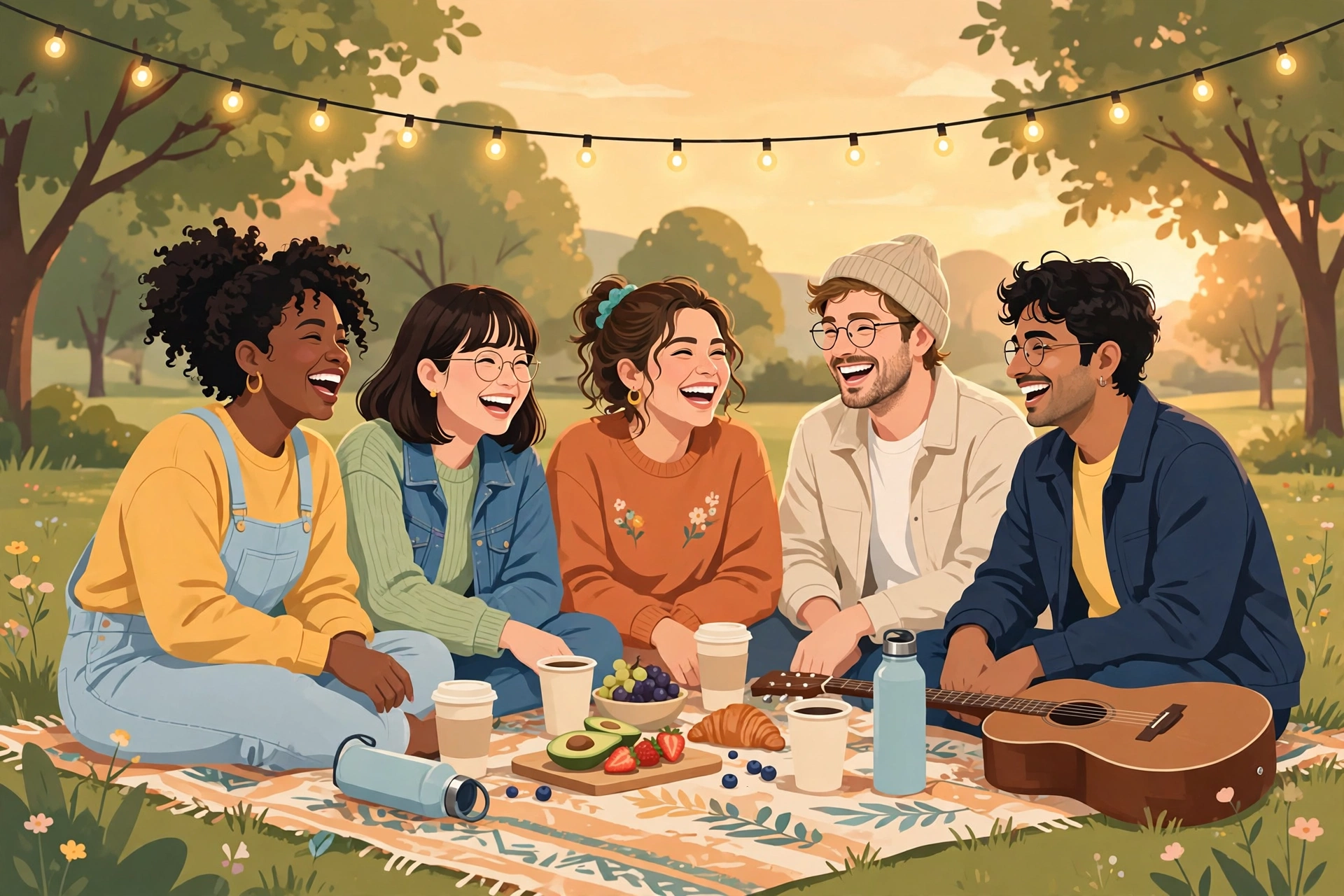
College hands you friendships on a conveyor belt: dorms, dining halls, group projects, the same people four years running. Then you graduate, and the machine switches off. Suddenly you’re in a new city or a first apartment or a first job, surrounded by strangers who all seem to already have their people, and nobody tells you that the old way of making friends is simply gone.
If that’s you, this list is for you. These are 101 concrete, specific things you can do in your 20s — after college, at your first job, in a new city — to meet people and turn them into real friends. Not vague advice like “be open.” Actual moves you can make this week.
A quick reality check first, because it helps: friendship researcher Jeffrey Hall found it takes roughly 50 hours together to move from acquaintance to casual friend and over 200 hours to become close friends (Hall, 2018) — the friendship machine of your 20s runs on repeated contact, not on one great conversation. And you’re not behind: the U.S. Surgeon General’s 2023 advisory reported the highest loneliness rates among young adults, and a 2023 Pew survey found 8% of U.S. adults say they have no close friends at all. You’re not broken. You’re just in the decade where everyone quietly starts over. (The research behind this list is unpacked in the next section.)
Pick one section that matches your life right now. Do three things from it this month. That’s how this works.
What the Research Says About Friendship in Your 20s
It takes more time together than you’d guess. Communication researcher Jeffrey Hall (University of Kansas) tracked how friendships form and found it takes roughly 50 hours together to go from acquaintance to casual friend, about 90 to become a real friend, and over 200 to become close friends (Hall, 2018). That’s why so many items in this list are about showing up repeatedly — friendship runs on contact hours, not on one great conversation.
If you feel lonely, you’re in large company. The U.S. Surgeon General’s 2023 advisory declared loneliness a public-health issue, reporting that about half of U.S. adults experience measurable loneliness, with the highest rates among young adults — and that lacking social connection carries health risks comparable to smoking (Office of the U.S. Surgeon General, 2023).
Losing friends after college is normal, not a personal failure. Pew Research Center (October 2023) found that 8% of U.S. adults have no close friends at all, and that friendship circles shift with life stages (Pew Research Center, 2023). Separately, sociologists tracking personal networks over time found that roughly 70% of close contacts turn over across seven years — rebuilding your circle in your 20s is what social networks do (Mollenhorst, Völker & Flap, 2014).
The fear of reaching out is mostly an illusion. In a series of studies, researchers at Yale, Cornell, Harvard, and the University of Essex found that people consistently underestimate how much a conversation partner liked them — the “liking gap” (Boothby et al., 2018). The person you’re nervous to invite will probably be flattered, not bothered.
And it’s hitting your age group hardest at work, too. The APA Work in America survey” target=”_blank” rel=”noopener”>American Psychological Association’s 2024 Work in America survey found that 45% of workers aged 18–25 feel lonely at work — far more than any older age group (APA, 2024).
How This Article Was Put Together
This guide is about making friends in your 20s specifically — the post-college years of first jobs, new cities, and roommates. If you’re looking for advice for your 30s, or for making friends as an introvert, we have separate guides for those.
The advice here is shaped by published research on friendship: Jeffrey Hall’s study on how many hours it takes to build a friendship (University of Kansas, 2018), the U.S. Surgeon General’s 2023 advisory on loneliness, a 2023 Pew Research Center survey on friendship, the American Psychological Association’s 2024 Work in America survey, the “liking gap” studies (Boothby et al., 2018), and research on how personal networks change after big life transitions (Mollenhorst, Völker & Flap, 2014). We also drew on widely shared post-college advice from real twenty-somethings in online communities.
Every factual claim is tied to a named source. Example conversations are invented illustrations, labeled as such. Researched October 2026. Nothing here was personally tested by us, and no experts were interviewed.
At Your First Job
Your first job is the closest thing adult life has to a classroom: the same people, same place, day after day. Use that repeated contact on purpose.
1. Eat lunch with someone new at least once a week instead of at your desk — the break room is the new cafeteria.
2. Say yes to the first three after-work invitations you get, even if you’re tired — early yeses decide who thinks of you next time.
3. Join the work Slack or Teams channel that isn’t about work (pets, food, running) and actually post in it.
4. Ask a coworker who’s been there longer to show you their favorite lunch spot — people love being the local expert.
5. Volunteer for the onboarding buddy role when a new hire starts; helping newcomers is the fastest way to look friendly.
6. Suggest a low-key Friday tradition for your team, like a 4pm walk or a shared snack run — rituals beat one-off events.
7. Remember one personal detail about each coworker (their dog’s name, their hometown team) and ask about it later — that follow-up is what turns desk-mates into friends.
8. Join or start a work-adjacent interest group: book club, run club, board game lunch, fantasy league.
9. If your company has ERGs (employee resource groups) or young-professionals networks, attend one meeting as a trial — they’re built for people exactly like you.
10. Ask a coworker near your age to grab coffee and talk honestly about the first-job learning curve — shared confusion bonds people fast.
In a New City: The First 90 Days
Moving somewhere new in your 20s is the hardest social reset. Give yourself a 90-day plan instead of hoping it happens.
11. Unpack fast and get out of your apartment — an empty, box-filled flat is a trap that keeps you inside.
12. Become a regular somewhere within the first two weeks: a coffee shop, a gym, a climbing wall. Familiar faces are the raw material of friendship.
13. Join your city’s subreddit and its Discord if it has one; post in the weekly “looking for friends” threads instead of just lurking.
14. Look for a “new to [city]” Meetup or Facebook group — everyone there is in the same boat, which removes the awkwardness.
15. Take one free walking tour of your new city in the first month — they’re full of other newcomers.
16. Get a library card and go to one library event; libraries run free classes, game nights, and clubs in most cities.
17. Find the young-professionals or 20s-and-30s social groups on Meetup and commit to going three times before judging — the first visit is always the weirdest.
18. Ask your landlord or building manager about tenant events; apartment complexes with social programming exist — use it.
19. Volunteer for a one-day event (a race, a festival, a cleanup) within your first month — low commitment, instant batch of friendly faces.
20. Tell everyone you meet that you’re new to the city — it’s the single most effective sentence for getting invitations, because people love introducing newcomers to their favorite things.
Roommates & Housing
In your 20s, your home is a social venue whether you plan it that way or not. Make it work for you.
21. If you’re choosing between living alone and having roommates, know that roommates multiply your social contact for free — factor friendship into the rent math.
22. Host a low-effort housewarming (pizza, BYOB) and invite your roommates’ friends — one party can triple your local contacts.
23. Cook one shared meal a week with your roommates, even something simple like tacos — the kitchen table is where roommate friendships actually form.
24. Ask your roommate to bring you along to one of their plans per month — piggybacking on an existing social life is legitimate.
25. If your roommate is great, say so out loud and mean it — small appreciation keeps the household warm instead of transactional.
26. Propose a monthly “open house” night where everyone can bring one friend — your circle grows one guest at a time.
27. Trade a skill with a roommate or neighbor: you cook, they fix the bike. Shared projects build trust faster than small talk.
28. If you live alone, join a co-living space or house-share for your next move — intentional community housing exists in most big cities now.
29. Knock on one neighbor’s door with a small hello in your first week — apartment neighbors in their 20s are often hoping someone else goes first.
30. Start a building or block group chat for practical stuff (packages, parking) — it quietly becomes a social channel too.
Classes, Clubs & Activities
The post-college version of “join a club” — but pick things where you see the same people weekly.
31. Take a class that meets at least four times: pottery, improv, a language, cooking — repetition is the whole point.
32. Join a recreational sports league in the beginner division (kickball, softball, volleyball) — they’re engineered for socializing, and nobody cares if you’re bad.
33. Try a martial arts or boxing gym with a beginner program — partner drills force interaction without forced conversation.
34. Sign up for a community theater production, even backstage — rehearsal schedules create instant friend groups.
35. Join a choir or community band — weekly rehearsals plus performances bond people unusually fast.
36. Take a dance class series (salsa, swing, hip-hop) — partner rotation means you meet everyone in the room.
37. Volunteer to coach a youth sports team or mentor through a local program — coaching staffs become tight-knit quickly.
38. Join a hiking or running club that does the same route weekly — the “see you next Saturday” effect does the work for you.
39. Sign up for a local makerspace, woodshop, or craft studio membership — project-based spaces attract friendly regulars.
40. Audit a class at a nearby community college for fun — cheap, structured, and full of curious people your age.
Apps & Online-to-Offline
Apps are fine as a starting line — the rule is that every match or group must lead to an in-person plan within two weeks, or it doesn’t count.
41. Try Bumble BFF for one month with a real commitment: swipe, chat, and actually meet up — treat it like dating for friends, because it is.
42. Use Meetup’s filters for 20s-30s age ranges and your actual interests, not generic “social” groups — specificity gets better matches.
43. Join Geneva or a similar group-chat app community for your city or interest — the chat-to-hangout pipeline is smoother than on bigger platforms.
44. Try Timeleft or a stranger-dinner app once — eating with five strangers sounds scary, and that’s exactly why everyone there is friendly.
45. Join a Discord server for your city or hobby and go to one IRL meetup it organizes — online rapport makes the first in-person hello easy.
46. Use the “looking for group” features in games you already play, then suggest voice chat — gaming friendships count, and they can go offline too.
47. Follow local event accounts on Instagram and actually go to one event a month alone — event pages full of “going solo?” comments are a green light.
48. Check your city’s event calendars (Eventbrite, local blogs) for free 20s-oriented events: gallery nights, trivia, outdoor movies.
49. Join an alumni chapter group for your college in your city — shared school ties make first conversations effortless.
50. Post a genuine “new here, looking for people to [hike/play board games/grab coffee]” in your city’s community groups — specificity beats “anyone want to hang out?”
Keeping College Friends After Graduation
New friends matter, but keeping the good ones you already have is the other half of the equation.
51. Create one group chat with your core college circle and give it a name — named groups survive; unnamed ones die.
52. Schedule a recurring call or video hangout (monthly is fine) and put it on the calendar like a meeting — “we should catch up sometime” never happens without a slot.
53. Plan one trip per year with college friends, even a cheap weekend — shared trips are friendship glue.
54. Send the “thinking of you” text when something reminds you of them — it takes 20 seconds and keeps the thread alive for months.
55. Share the small stuff: a funny meme, a song, a photo of your lunch — friendship runs on low-stakes contact, not just big news.
56. Celebrate their wins loudly — a new job, a move, a birthday — because distance makes people feel forgotten, and attention fixes it.
57. Be honest when you’re drifting: “I miss how close we were — can we do a monthly call?” works better than silent guilt.
58. Visit them where they live instead of always meeting halfway — showing up in someone’s city says the friendship matters.
59. Keep one shared ritual from college alive: the fantasy league, the annual ranking of movies, the group playlist — rituals survive distance.
60. Accept that some college friendships will fade, and that’s normal — invest most in the ones where effort flows both ways (Mollenhorst, Völker & Flap, 2014).
Sober & Low-Drinking Options
A lot of 20s social life revolves around bars. If that’s not your scene — or not always your scene — you need alternatives, and they exist.
61. Suggest coffee, breakfast, or boba instead of drinks as the default first hangout — daytime plans are easier to say yes to anyway.
62. Join a morning activity group (run club, cycling, sunrise hikes) — they self-select for people who aren’t out late drinking.
63. Look for explicitly sober or “sober-curious” social groups in your city — they exist on Meetup and Instagram in most metro areas now.
64. Host a game night with mocktails — you get the party energy without the bar tab or the hangover.
65. Take a cooking or baking class — hands busy, conversation easy, zero alcohol required.
66. Go to matinee movies, museum free-days, or daytime festivals — cultural plans are naturally drink-optional.
67. Join a volunteer crew that meets on weekend mornings — service projects attract the low-key crowd.
68. Suggest active plans (climbing gym, kayaking, bike rides) where drinking isn’t part of the format.
69. Be upfront and casual about it: “I’m not drinking tonight, but I’m in for everything else” — most people in their 20s genuinely don’t care.
70. Find the friend who also wants fewer bar nights and make them your co-conspirator — planning sober fun is easier with one ally.
Introvert-Friendly Paths (the 20s Edition)
You don’t need to become a party person. You need settings where 20s life and quiet energy overlap. (If you want the full deep dive on introvert friendship, see our guide: How to Make Friends as an Introvert.)
71. Choose recurring small-group activities over big mixers: a weekly D&D table, a climbing partner, a two-person language exchange.
72. Arrive early to events — it’s far easier to talk to the three people setting up than to break into a room of fifty.
73. Volunteer for roles with a job to do (check-in table, photographer, scorekeeper) — having a task removes the pressure to “mingle.”
74. Use parallel-play hangouts: study together, work at the same café, do separate crafts in the same room — company without performance.
75. Ask one thoughtful question instead of making small talk — “what’s the best thing you’ve done this month?” beats “so what do you do?” every time.
76. Leave events when your energy is done, and say so warmly: “I had a great time — I’m heading out while I’m ahead.” No apology needed.
77. Suggest 1-on-1 versions of group activities: “want to check out that trail just the two of us Saturday?” — many 20-somethings prefer it too.
78. Join online communities for your niche interests (a fandom, a craft, a game) and meet the local members — shared obsession skips small talk entirely.
79. Keep a short list of low-energy invitations ready: walk, coffee, bookstore browse, co-working session — so you never stall at “we should do something.”
80. Remember that in your 20s, saying “I’m more of a small-group person” is completely normal — own the preference instead of apologizing for it.
What to Actually Do Together
“Let’s hang out” dies in the group chat. Specific, repeatable plans live. Steal these.
81. Start a weekly or biweekly ritual: trivia night, Sunday hike, Friday dumplings — the standing plan removes the “when are we free?” spiral.
82. Cook a meal together instead of going out — grocery run plus cooking is three hours of contact for the price of one dinner.
83. Do errands together: farmers market, thrift store run, IKEA trip — mundane plans are secretly great friendship builders.
84. Start a two-person book club, watch club, or album club — one shared thing per week gives you endless conversation.
85. Exercise together: gym sessions, long walks, pickup basketball — the endorphins do half the bonding work.
86. Explore your city like tourists: pick a neighborhood a month and walk it properly.
87. Take on a small project together: a garden plot, a puzzle, a short film, a zine — finishing something together cements friendships.
88. Celebrate small wins together: promotions, finished exams, signed leases — being there for the ordinary milestones matters.
89. Do the “yes day” once a season: one person plans a full day, the other just shows up — it breaks routine fast.
90. Keep a shared photo album or group chat thread of your hangouts — looking back at what you’ve done together makes the friendship feel real.
The “Go First” Problem: Asking Without It Being Weird
Here’s the secret the research backs up: people consistently underestimate how much others will like them. In a 2018 study, researchers at Yale, Cornell, Harvard, and the University of Essex found that conversation partners like each other more than either side expects — the “liking gap.” Translation: the person you’re nervous to invite will probably be flattered. Someone has to go first. Let it be you.
91. Use the specific-invitation rule: never “we should hang out sometime” — always “are you free for coffee Saturday morning?” People like you more than you think (Boothby et al., 2018).
92. Invite people to things you’re already doing: “I’m checking out the new ramen place Thursday — want to join?” Low pressure, easy yes (Boothby et al., 2018).
93. Follow up within a day or two of a good conversation with one short message referencing something real you talked about.
94. When someone says they’re busy, offer one specific alternative, then let them counter — two tries is friendly, five is pressure.
95. Ask for their number or social handle before the conversation ends, not after — “let me grab your number so we can do this again” is normal.
96. Invite one person, not the group, when you want to deepen a connection — 1-on-1 is where acquaintances become friends.
97. Tell people you’re new or new-ish: “I’m still building my circle here” — honesty about wanting friends gives others permission to admit the same (Boothby et al., 2018).
98. Re-invite someone even if the first plan fell through — schedules in your 20s are chaos, and a second ask shows genuine interest.
99. Introduce your separate friends to each other — being the connector makes you the center of a circle instead of the edge of several.
100. Say yes when others go first, quickly and warmly — nothing kills a new friendship faster than a slow, lukewarm reply.
101. Keep a private note of who you want to see more of and when you last reached out — unromantic, wildly effective, and nobody ever has to know.
Frequently Asked Questions
Is it normal to have fewer friends after college?
Yes — it’s the norm, not the exception. College is an artificial friendship machine: shared housing, shared schedules, same age group, four years of daily contact. When it ends, your social circle shrinks because the structure that built it is gone. A 2023 Pew survey found 53% of U.S. adults have just one to four close friends. Rebuilding takes deliberate effort, and that’s true for almost everyone in their 20s.
How long does it take to make friends in a new city?
Expect 3–6 months of consistent effort before it feels like you have a real circle. The research backs this up: Jeffrey Hall’s University of Kansas study found it takes about 50 hours together to become casual friends and 90+ hours to become real friends. A weekly two-hour activity gets you to 50 hours in about six months. That’s the math — which is why repetition matters more than any single great night out.
How do adults make friends without drinking?
Shift the format, not just the beverage. Morning activities (run clubs, hikes, cycling), classes, volunteering, game nights, and cultural plans (museums, matinees, festivals) are all naturally drink-optional. Be casual about it — “I’m not drinking tonight but I’m in for everything else” — and find one co-conspirator who wants fewer bar nights too. Plenty of 20-somethings are cutting back; you’re not alone in it.
I work remotely — what then?
Remote work removes the easiest friendship source, so you have to build your own “office”: a regular co-working space or café routine, a weekly class, a rec league, or a volunteer shift. The key is scheduled, repeated, in-person contact with the same people. Online communities count too, but aim for ones that meet in person occasionally.
Are friendship apps like Bumble BFF or Meetup actually worth it?
They’re worth it as a starting line, not a finish line. They work when you treat them like dating for friends: show up, chat briefly, and meet in person within two weeks. They fail when they become endless scrolling. Set a rule before you download one — three real meetups in the first month, or delete it.
How do I keep college friends while making new ones?
Protect the old friendships with structure: a named group chat, a recurring monthly call, one trip a year. Share the small stuff, not just big news. And be honest when you’re drifting — “I miss how close we were” beats silent guilt. Some friendships will fade no matter what; invest most where the effort flows both ways.
Do friendships get harder after 25?
The mechanics don’t change at 25 — what changes is that the built-in structures (school, dorms, entry-level cohorts) keep disappearing while responsibilities grow. The U.S. Surgeon General’s 2023 advisory found loneliness rates are highest among young adults and have been rising for decades. It’s not you; it’s the life stage. The fix is the same at 24 and 34: repeated contact around shared activities.
How do you ask someone to hang out without it being weird?
Be specific, be casual, and make it easy to say no — which paradoxically makes yes more likely. “I’m checking out the farmers market Saturday morning — want to come?” beats “we should hang out sometime” every time. And remember the liking gap: research shows people like you more than you think they do. The awkwardness is mostly in your head.
I’m in my late 20s — is this list still for me?
Yes. Everything here works from about 20 to 30. And when you’re ready for the next decade’s version, we have you covered: How to Make Friends in Your 30s.
What if I try all this and it doesn’t work?
Then you’re having a normal human experience, not a personal failure. Friendship has a luck component — timing, chemistry, other people’s availability. The research says it takes months of repeated contact, so judge the strategy on a 6-month timeline, not a 6-day one. If loneliness is affecting your daily life, talking to a counselor or therapist is a strong move, not a last resort.
About This Article
This article is for 20-somethings rebuilding their social life after college — first jobs, new cities, roommates, and keeping old friendships alive. It promises no guaranteed friendships: the research is clear that friendship takes time and repeated contact, and chemistry and luck play a role no list can control. What it offers is 101 concrete, specific moves, each checked against published research or clearly labeled as an invented illustration. We follow the editorial standards in our Editorial Policy: real sources for factual claims, no fabricated expertise or testimonials, and corrections when we’re wrong. If you spot an error, tell us through the contact page.
Sources & Further Reading
– Jeffrey A. Hall, “How many hours does it take to make a friend?” Journal of Social and Personal Relationships, 36(4), 1278–1296 (published online 2018; in print 2019) — roughly 50 hours to casual friend, 90 to friend, 200+ to close friend. – Office of the U.S. Surgeon General, Our Epidemic of Loneliness and Isolation: The U.S. Surgeon General’s Advisory on the Healing Effects of Social Connection and Community, 2023 — about half of U.S. adults report measurable loneliness, with the highest rates among young adults; lacking social connection carries health risks comparable to smoking. – Pew Research Center, “What does friendship look like in America?” October 12, 2023 — 8% of U.S. adults have no close friends; 53% have 1–4. Pew Research Center report – American Psychological Association, 2024 Work in America survey — 45% of workers aged 18–25 report feeling lonely at work, far more than any older age group. APA Work in America survey – Mollenhorst, G., Völker, B. & Flap, H. (2014). Longitudinal research on personal-network turnover, Social Networks — roughly 70% of close contacts change over a seven-year span. – “Liking gap” research: Boothby, Cooney, Sandstrom & Clark, Psychological Science, 2018 — people consistently underestimate how much conversation partners like them (researchers at Yale, Cornell, Harvard, and the University of Essex).
Related on 101Thing
– How to Make Friends in Your 30s — the next decade’s version of this guide. – How to Make Friends as an Introvert — the full deep dive on low-pressure friendship for quieter energy. – 101 Questions to Ask New Friends to Get to Know Them — once you’ve met people, here’s what to talk about. – 101 Ice Breakers for Any Situation — openers for work, parties, and group settings. – 101 Small Talk Topics for Introverts — low-pressure conversation starters.

As a lifestyle contributor at 101 Thing, she focuses on researching and sharing practical ideas that make everyday life more useful, interesting, and enjoyable. Her work combines thoughtful research, real-world examples, reliable sources, and careful fact-checking to help readers make informed decisions. She believes good content should be more than interesting — it should be accurate, helpful, trustworthy, and genuinely worth a reader’s time.
 101Thing