


How This Article Was Put Together
This guide was put together by researching the questions people ask about starting conversations with strangers — where to begin, what to say first, how to read signals, and how to exit gracefully — and organizing them into clear steps: mindset, openers, listening, and polite exits. Each suggestion was checked for clarity, respect, and practicality, and anything pushy, intrusive, or unsafe was left out. Try one opener in a low-pressure setting first. Written by the 101Thing team and reviewed for clarity and safety.
About This Article
This article is part of the 101 Thing library of practical lists and guides, and it focuses on how to Start a Conversation With a Stranger Without Being Awkward — 101Thing Guide. Its sections — including “The Simple Plan: How to Start a Conversation With a Stranger” and “10 Ready-to-Copy Scripts for Real Situations” — are organised so you can jump straight to the part that matches your situation and use it right away. Treat everything here as a starting point rather than a script: adapt the wording to your own voice, skip anything that does not fit, and put your own experience ahead of any list. We update our articles when we find errors or a better approach, and readers are welcome to suggest corrections through our contact page. For more on how we research and check the content we publish, see our Editorial Policy.
Introduction: Why Talking to Strangers Feels So Awkward
You see someone you would like to talk to — at a coffee shop, at work, at the gym — and then your mind goes blank. What do I say? What if they think I am weird? What if there is a long, painful silence?
If that sounds familiar, you are not bad at talking to people. Starting a conversation with a stranger is awkward for most people because it involves uncertainty. You do not know if the other person wants to chat, what they are interested in, or how they will respond. Your brain treats that uncertainty as a risk, so it fills the gap with worst-case scenarios.
Here is the mindset shift that makes everything else in this guide work:
Your job is not to impress a stranger. Your job is to make the next 30 seconds easy for both of you.
You do not need a clever line, a perfect introduction, or a fascinating story. You need a short, kind, low-pressure opener — and permission to let the conversation end gracefully if it does not click. Most friendly conversations start with something ordinary: a shared situation, a simple question, or a small observation. The “awkwardness” usually comes from overthinking the opening, not from the opening itself.
This guide gives you a simple step-by-step plan, 10 ready-to-copy scripts for real situations, and clear ways to exit, recover from short answers, and practise without putting pressure on yourself.
Want more opener ideas? If you would like a bigger bank of lines to draw from, see our companion post: 101 Tips for Starting a Conversation With a Stranger. Use this guide for the method and the scripts below for real situations; use that list when you want extra options.
The Simple Plan: How to Start a Conversation With a Stranger
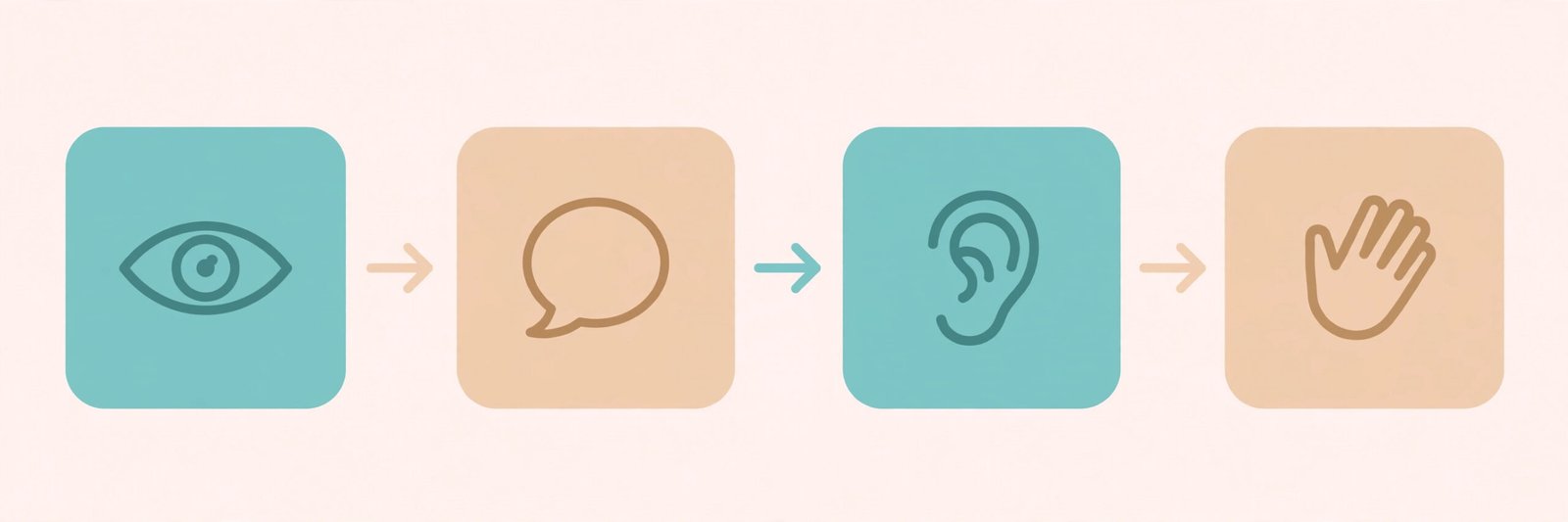
Think of every stranger conversation as four small steps: Notice → Open → Ask and Listen → Respond or Exit. You do not need to get through all four. A friendly 30-second exchange counts.
Step 1: Read the Room (Before You Say Anything)
A good opener starts before you speak. Take five seconds to notice context and signals.
Look for a shared situation. The easiest conversations grow out of something you are both experiencing: the same long line, the same event, the same class, the same weather, the same menu confusion. Shared context gives you something natural to talk about without making it personal.
Check whether the moment is right. Good moments are usually when the other person looks unhurried and open — standing nearby, looking around, waiting, browsing, or already chatting with others. Pause or skip it if the person:
- is wearing headphones, on a phone call, or clearly focused on work;
- is walking quickly, looking away, or moving away from people;
- looks upset, tired, or uncomfortable;
- is alone in an isolated place, in a lift late at night, or in any setting where approaching could feel unsafe;
- has already given short, closed-off answers to someone else.
Reading the room is not about being perfect at reading people. It is about choosing moments where a brief, friendly comment is welcome rather than intrusive.
Choose low-stakes settings first while you practise. A community class, a work event, a volunteer shift, or a queue where chatting is normal is easier than approaching someone who is clearly trying to be left alone.
Step 2: Use Openers That Work
The best openers share three qualities: they are short, specific, and easy to answer.
- Short: One or two sentences. Long introductions create pressure.
- Specific: Tied to something you can both see or are both doing, not a generic “So, what’s up?”
- Easy to answer: The other person can reply in a few words without revealing anything personal.
A useful formula is:
Observation + simple question
>
Example: “That pastry looks good — have you tried it before?”
Other reliable opener types:
- Ask for a small bit of help or information: “Do you know if this bus stops near the library?”
- Comment on the shared situation: “This line is moving slowly today.”
- Give a brief, sincere compliment about a choice, not appearance: “That book looks interesting — would you recommend it?”
- Introduce yourself in settings where that is expected: “Hi, I’m Alex — I think we’re in the same workshop. What did you think of the first session?”
Avoid openers that demand too much too soon: deep personal questions, compliments about someone’s body, jokes that could be misunderstood, or anything that requires the other person to explain themselves to a stranger.
Step 3: Use Body Language That Makes People Comfortable
People notice how you approach before they process what you say. Aim for relaxed and open, not intense or performative.
- Face the person lightly, not square-on. Standing at a slight angle feels less confrontational than standing directly in front of someone.
- Keep a comfortable distance. About an arm’s length is a good default. If they step back, do not step forward.
- Uncross your arms, put your phone away, and make brief eye contact. Then look away naturally. Steady staring feels like pressure; brief, warm eye contact feels friendly.
- Smile lightly. You do not need a big grin. A relaxed, genuine-looking smile is enough.
- Match their energy. If they sound quiet and calm, keep your voice calm. If they are upbeat, you can be a little warmer. Mirroring pace and volume helps a conversation feel natural.
- Watch for their cues. Leaning in, eye contact, asking you a question back, or smiling are signs they are happy to keep talking. Turning away, one-word answers, no eye contact, or stepping away are signs to wrap up kindly.
Step 4: Keep It Going With One Good Follow-Up
You do not need to carry the whole conversation. After your opener, use this simple pattern:
1. Listen to their answer.
2. React briefly (“Oh nice,” “That makes sense,” “I’ve been meaning to try that.”)
3. Share a little about yourself — one short sentence, not your life story.
4. Ask an open question — one that cannot be answered with just “yes” or “no.”
Example:
Them: “Yeah, I’ve tried it — the almond one is really good.”
You: “Good to know — I was torn between that and the plain croissant. Do you come here often, or was this a first visit?”
If the conversation flows, great. If it stalls after two exchanges, that is normal. Not every interaction has to become a long conversation or a friendship.
Step 5: How to Exit Gracefully (Without It Being Awkward)
Knowing how to leave is what makes starting feel less scary. A graceful exit is short, warm, and clear. You do not need an excuse or a dramatic reason.
Try one of these:
- “It was nice chatting with you — I’ll let you get back to your day.”
- “I should get going, but I’m glad we talked. Have a good one!”
- “I’ll let you get back to your book — enjoy the rest of your afternoon.”
- “I need to head off, but it was nice meeting you.”
If you would genuinely like to stay in touch — for example, after talking to someone at a work event or a class — keep it light and optional:
“It was nice meeting you. If you’re ever up for grabbing coffee after class, I’m usually here on Tuesdays — no pressure at all.”
Giving the other person an easy “no” is part of being respectful. If they do not take you up on it, smile, say “No worries — take care,” and move on.
10 Ready-to-Copy Scripts for Real Situations
Copy these word for word, or adapt the wording to sound like you. Each script includes an opener, a follow-up, and a graceful exit so you know what to say at every stage.
1. Coffee Shop
Opener: “Hi — sorry to interrupt. That drink looks good. What is it?”
Follow-up: “I’m trying to branch out from my usual order. Would you get it again?”
If it goes well: “I might try that next time. Do you come to this place often?”
Exit: “Well, I’ll let you enjoy your coffee. It was nice chatting!”
Why it works: You are commenting on something they chose, in a place where brief chats are normal.
2. Waiting in Line
Opener: “This line is longer than I expected. Have you been waiting long?”
Follow-up: “I’m just picking up [a coffee / a parcel / tickets]. Are you here for something good?”
If it goes well: “At least the wait is giving us time to plan. What are you up to after this?”
Exit: “Looks like it’s almost your turn — hope the rest of your day goes quickly!”
Why it works: Waiting gives you a shared situation and a natural time limit. The conversation can end when one of you reaches the front.
3. Work Event or Conference
Opener: “Hi, I’m [your name]. Are you here for the [talk / workshop / team event] too?”
Follow-up: “What did you think of the first session? I found the part about [topic] interesting.”
If it goes well: “What kind of work do you do? I’m in [your area], so I’m curious how this applies in other teams.”
Exit: “It was great meeting you. I’ll let you catch the next session — hope you enjoy the rest of the event.”
Why it works: At work events, introductions are expected. Naming the shared event removes the “why are you talking to me?” question.
4. Coworker You Have Not Really Talked To Yet
Opener: “Hi, I don’t think we’ve properly met — I’m [your name], I work on [team / floor]. How are you finding things here?”
Follow-up: “I’ve seen you in the [kitchen / lift / Monday meeting]. How long have you been on the team?”
If it goes well: “If you ever want a coffee break walk, I’m usually up for one around mid-morning.”
Exit: “Anyway, I should get back to it — nice to finally say hi properly.”
Why it works: You acknowledge the situation honestly instead of pretending you already know each other.
5. Gym
Opener: “Hi — do you know if this machine is free, or are you still using it?”
Follow-up (only if they seem open to chatting): “Thanks. I’m still figuring out the layout here. Have you been coming long?”
If it goes well: “I’m trying to get into a regular routine. Do you have a favourite class here?”
Exit: “Thanks for your help — I’ll let you get back to your workout.”
Why it works: At the gym, most people want to exercise, not chat. Ask a practical question first, keep it short, and let them decide whether to continue. Never interrupt someone mid-set, comment on their body, or follow them around the gym.
6. Neighbour
Opener: “Hi — I think we live in the same building / on the same street. I’m [your name]. How long have you lived here?”
Follow-up: “I’m still learning my way around. Is there a good [café / park / shop] nearby you’d recommend?”
If it goes well: “That’s helpful — thank you. I’ll have to try it this weekend.”
Exit: “Well, I’ll let you get on — nice to meet you properly. See you around!”
Why it works: Neighbours share a long-term context, so a brief, friendly introduction builds comfort over time without forcing friendship.
7. Party or Social Gathering
Opener: “Hi, I’m [your name]. How do you know [the host / the person celebrating]?”
Follow-up: “How long have you known them? I met them through [work / school / a class].”
If it goes well: “Have you tried the food yet? I’m still deciding what to try first.”
Exit: “I’m going to go say hi to a couple of other people, but it was really nice talking to you.”
Why it works: “How do you know the host?” is a classic party opener because almost everyone can answer it easily.
8. Public Transport (Bus, Train, or Plane)
Opener (only if the moment feels relaxed and they are not wearing headphones or working): “Excuse me — do you know if this [bus / train] stops at [station]?”
Follow-up: “Thanks — I don’t take this route very often. Are you heading somewhere interesting?”
If it goes well: Keep it light and situational. Talk about the journey, the weather, or something you can both see.
Exit: “This is my stop coming up — have a good journey!”
Why it works — and when to skip it: Public transport is a low-interaction setting for many people. A short, practical question is fine. If they give a short answer and turn away, take that as a polite close. Do not try to keep a conversation going with someone who clearly wants quiet, and never block their path or follow them after they get off.
9. Class, Course, or Workshop
Opener: “Hi, I’m [your name]. Did you understand that last part about [topic]? I want to make sure I’ve got it right.”
Follow-up: “What made you sign up for this class? I joined because [short reason].”
If it goes well: “Would you want to compare notes after next week’s session? It might help us both.”
Exit: “I should grab my things — see you next week!”
Why it works: Classes give you repeated, low-pressure contact. You do not need to become friends in one conversation; you can build familiarity gradually.
10. Bookshop, Market, or Hobby Shop
Opener: “Excuse me — I noticed you’re looking at [book / plant / item]. Have you read / tried anything like it before?”
Follow-up: “I’m looking for [a gift / something new to try]. Would you recommend this one?”
If it goes well: “That’s a good tip — thank you. What else have you enjoyed in this area?”
Exit: “Thanks for the recommendation — I’ll give it a try. Have a good day!”
Why it works: Shops built around interests make conversation natural, because the topic is the item, not the person.
What NOT to Do When Talking to a Stranger
Avoiding a few common mistakes matters more than finding the perfect line.
- Don’t open with something personal or intense. Avoid comments about someone’s body, age, relationship status, or appearance, and avoid trauma, politics, or heavy life questions with someone you just met.
- Don’t demand attention. Do not tap someone repeatedly, block their path, follow them, raise your voice to be heard over headphones, or keep talking after they have tried to end the conversation.
- Don’t make it a performance. You do not need to be funny, impressive, or endlessly interesting. Trying too hard often feels more awkward than a simple, honest opener.
- Don’t interview the other person. Asking question after question without sharing anything yourself can feel like an interrogation. Share a little, then ask.
- Don’t overshare early. Keep early conversation light. Save personal problems, strong opinions, and detailed life history for people who know you well.
- Don’t touch a stranger. A handshake is fine in settings where it is expected, such as a work event. Otherwise, do not touch someone you just met.
- Don’t take a short answer personally. A brief reply usually means “I’m busy,” “I’m tired,” or “I don’t want to chat right now” — not “You are unlikeable.”
- Don’t keep pushing if someone is uncomfortable. If their body language closes off, thank them and move on. Respecting a “no” — spoken or unspoken — is what makes you trustworthy.
If you are ever unsure whether to approach someone, choose not to. There will always be another moment, and leaving someone in peace is never the wrong choice.
How to Handle Rejection and Short Answers
Even friendly, confident people get short answers. Rejection in this context is rarely personal. Most strangers are busy, tired, shy themselves, or simply not in the mood to talk. Your goal is to handle it with grace — for your own confidence as much as for theirs.
If you get a one-word answer
Do not panic or try harder. Offer one light follow-up, then give them an easy exit.
Them: “Yeah.”
You: “Fair enough. Well, I’ll let you get on — have a good day.”
That is a complete, polite interaction. You were friendly, you read the cue, and you left well.
If they don’t look up or don’t respond
They may not have heard you, or they may not want to talk. Do not repeat yourself loudly or try again. A simple “No worries — have a good day” and moving on is enough.
If the chat stalls with a stranger
Silence feels longer to you than it does to the other person. If there is a pause, you can either:
- ask one more easy question (“So, are you from around here, or just visiting?”), or
- close warmly (“Anyway, it was nice chatting — I’ll let you go.”)
Either option is fine. You do not need to rescue every pause.
If you feel embarrassed afterwards
It helps to reframe what happened. You did something brave: you tried. Most people forget a brief, polite interaction within minutes. They do not replay it the way you do.
Try this short reset:
1. Name what went well: “I spoke up, I was polite, and I exited kindly.”
2. Name what was neutral: “They gave a short answer. That is information about their mood, not a verdict on me.”
3. Decide the next small step: “Next time, I’ll try once in a setting that feels easier.”
Confidence grows from repetition, not from every conversation going perfectly.
A 7-Day Practice Plan (Low Pressure, No Cold-Approaching Strangers on Day 1)
You do not need to walk up to strangers on day one. Build the skill gradually, starting with moments that already feel safe.
Day 1: Notice and smile
Practise noticing shared situations without starting a conversation. When you are out, silently note one easy opener you could have used (“We’re both waiting for the same bus”). Smile briefly at one person, such as a cashier or barista. That is enough.
Day 2: Say one low-stakes line to someone in a service role
Say something short and friendly to a cashier, barista, or receptionist: “Busy day today?” or “Thank you — hope your shift goes well.” These interactions are brief, expected, and good practice for speaking first.
Day 3: Comment on a shared situation
Make one short, situational comment to someone nearby: “This queue is moving slowly today,” or “It’s finally stopped raining.” You do not need to continue the conversation. The win is saying it out loud.
Day 4: Ask one open question
Start one brief conversation using an opener from this guide, then ask one open question: “What did you think of it?” or “What brought you here today?” Practise listening without planning your next line while they speak.
Day 5: Practise a graceful exit
Start one short conversation with the explicit goal of ending it well. Use one of the exit lines above. Notice how much less scary starting feels when you already know how you will leave.
Day 6: Try one new setting
Try one conversation in a setting you have not used yet — a class, a work event, a community activity, or a hobby group. Shared activities make conversation easier because you already have something in common.
Day 7: Review and repeat what worked
Ask yourself: Which opener felt most natural? Which setting felt easiest? Which exit felt kindest? Repeat the ones that fit you. You do not need to use every script. Keep two or three openers you like and reuse them until they feel automatic.
If a day feels too hard, repeat the previous day. Progress is not a straight line, and one friendly sentence is still progress.
About this article: the 101Thing team researched common questions about talking to strangers and organized the answers into practical, respectful steps.
FAQ
How do I start a conversation with a stranger without being awkward?
Keep it short, specific, and easy to answer. Comment on something you both share — the place, the event, the wait, or an item — then ask one simple question. For example: “That book looks interesting — would you recommend it?” Then listen, share a little about yourself, and let the conversation end gracefully if it does not flow. Awkwardness usually fades when you stop trying to be impressive and focus on making the next 30 seconds easy.
What should I say to a stranger for the first time?
Say something tied to the moment you are both in. A practical question (“Do you know if this bus stops near the library?”), a shared observation (“This line is moving slowly today”), or a brief introduction in settings where introductions are expected (“Hi, I’m Alex — I think we’re in the same workshop”) all work well. Avoid deep personal questions, compliments about someone’s body, or long introductions. One or two sentences is enough.
How do I talk to a stranger if I am shy or introverted?
Start small and choose settings that fit you. Practise with brief, low-stakes exchanges first — a friendly word to a cashier, a short comment in a queue, or a question in a class — before trying longer conversations. Use prepared openers so you do not have to invent one on the spot, and give yourself permission to keep conversations short. Being introverted does not mean you are bad at conversation; it often means you prefer fewer, more meaningful exchanges. That is a strength.
What if they just are not interested in chatting?
Respect it quickly and kindly. If they give short answers, avoid eye contact, turn away, or say they are busy, close the conversation with warmth: “No worries — have a good day.” Do not repeat yourself, follow them, or try to win them over. A polite exit leaves a good impression and protects your confidence for the next conversation.
The Bottom Line
You do not need to become a different person to talk to strangers. You need a simple plan, a few lines you trust, and a kind way to exit.
Remember the core idea: Notice → Open → Ask and Listen → Respond or Exit. Start with something shared, keep it short, listen more than you speak, and let the conversation be as brief as it needs to be.
If you want more lines to practise with, browse 101 Tips for Starting a Conversation With a Stranger and pick two or three that sound like you. Then try just one this week — in a queue, at a class, or at your next work event. A single friendly sentence is a good place to start.
Once the conversation is flowing, the next skill is keeping it alive past the first minute. Our guide to keeping a conversation going in person walks through the follow-up pattern — listen, react, share a little, ask one open question — with examples for when things stall.
And if the stranger you would like to approach is someone you are hoping to get to know better, read how to start a conversation with a girl in person — it covers respectful openers for that situation and how to read interest without overstepping.
Sources & Further Reading
Want to go deeper? These sources offer useful background on the topic above.
- Case Western Reserve Observer — On Small Talk, Awkwardness and the Fear of Social Interaction — Discusses why conversations feel awkward and how listening and body language can make them more comfortable.
- Psychology Today — 2 Responses to Avoid When Someone Opens Up to You — Explains why validating someone’s feelings matters more than judging or doubting their experience.
- Psychology Today — 5 Skills for Making Friends as an Adult — Describes practical skills for initiating and sustaining adult friendships, including assuming others like you.
Related reading: how to end a conversation

101Thing publishes practical guides and lists that help readers try new ideas, start conversations, and make everyday life a little better. Articles are researched, written, and reviewed for accuracy and usefulness before publication. Questions or corrections can be sent via the Contact page.
 Amna Qamar