

You’ve tried the lavender spray. You’ve counted sheep, then counted them again. It’s 2 a.m. and the ceiling is getting a very long stare.
Here’s the thing: better sleep rarely comes from one magic fix. It comes from a pile of small, boring habits that stack up over a few weeks. Below are 101 of them, grouped so you can skim, pick a handful, and start tonight.
Nobody needs all 101. I’d start with three, honestly. Give them two weeks, then add more.
also read : 101 Tips for Working Night Shifts and Still Having a Social Life
Sources & Further Reading
Want to go deeper? These reputable sources cover this topic in more detail.
- Sleep Foundation — How to Build a Better Bedtime Routine for Adults — The Sleep Foundation’s guide to building a better bedtime routine for adults.
- NHS — Sleep Problems — The NHS guide to sleep problems and how to sleep better.
Need sleepiness to arrive tonight rather than over the next few weeks? Begin with how to get tired fast, then use the habits in this article to make it stick.
How This Article Was Put Together
We put this list together by researching sleep tips commonly shared by sleep-health resources — routines, bedroom setup, daytime habits, and wind-down ideas — then grouping them by when to use them. Each tip was checked for clarity and for safety, so it stays general, practical, and non-medical. Duplicates were removed. This is general information, not medical advice. Written by the 101Thing team and reviewed for clarity and safety.
Your Body Clock Loves a Boring Schedule
The most powerful sleep habit is a steady wake-up time, weekends included. Your body clock runs on predictability, so a fixed rise time anchors everything else: when you feel sleepy, when you wake naturally, even how deep you sleep. Build your bedtime routine around it.
- Wake up at the same time every day, weekends included. If you change only one thing, change this.
- Keep bedtime within roughly 30–60 minutes of the same time each night.
- Head to bed when you actually feel sleepy, not just because the clock says so.
- Build a 30–60 minute wind-down routine — same steps nightly (shower, book, lights low) so your body learns sleep is next.
- Run that routine in the same order each night, so your brain learns the cue.
- Limit weekend sleep-ins to about an hour.
- After a rough night, still get up at your usual time.
- Protect a 7–9 hour sleep window.
- Set a “start winding down” alarm. Yes, an alarm for relaxing.
- Shifting your schedule? Move bedtime 15 minutes at a time.
- Keep naps under 20–30 minutes, and finish them before 3 pm.
- If you have insomnia, try skipping naps entirely.
A steady clock is half the battle. The other half is telling that clock what time it is, and light does the talking.
Light: The Loudest Signal Your Brain Hears
Get sunlight within an hour of waking, then dim your lights about two hours before bed. Morning light sets your body clock for the day; bright evening light can push sleepiness later. Think of it as a sunrise-sunset pair that you control.
- Get sunlight within an hour of waking — morning light sets your body clock so you feel sleepy about 16 hours later.
- Spend time outdoors during the day.
- Work near a window if you can.
- Dim the lights two hours before bed — lower light in the evening lets melatonin rise on time.
- Use warm, low-wattage bulbs in the evening.
- Reach for lamps instead of bright overhead lights at night.
- Use a dim amber or red night-light for bathroom trips.
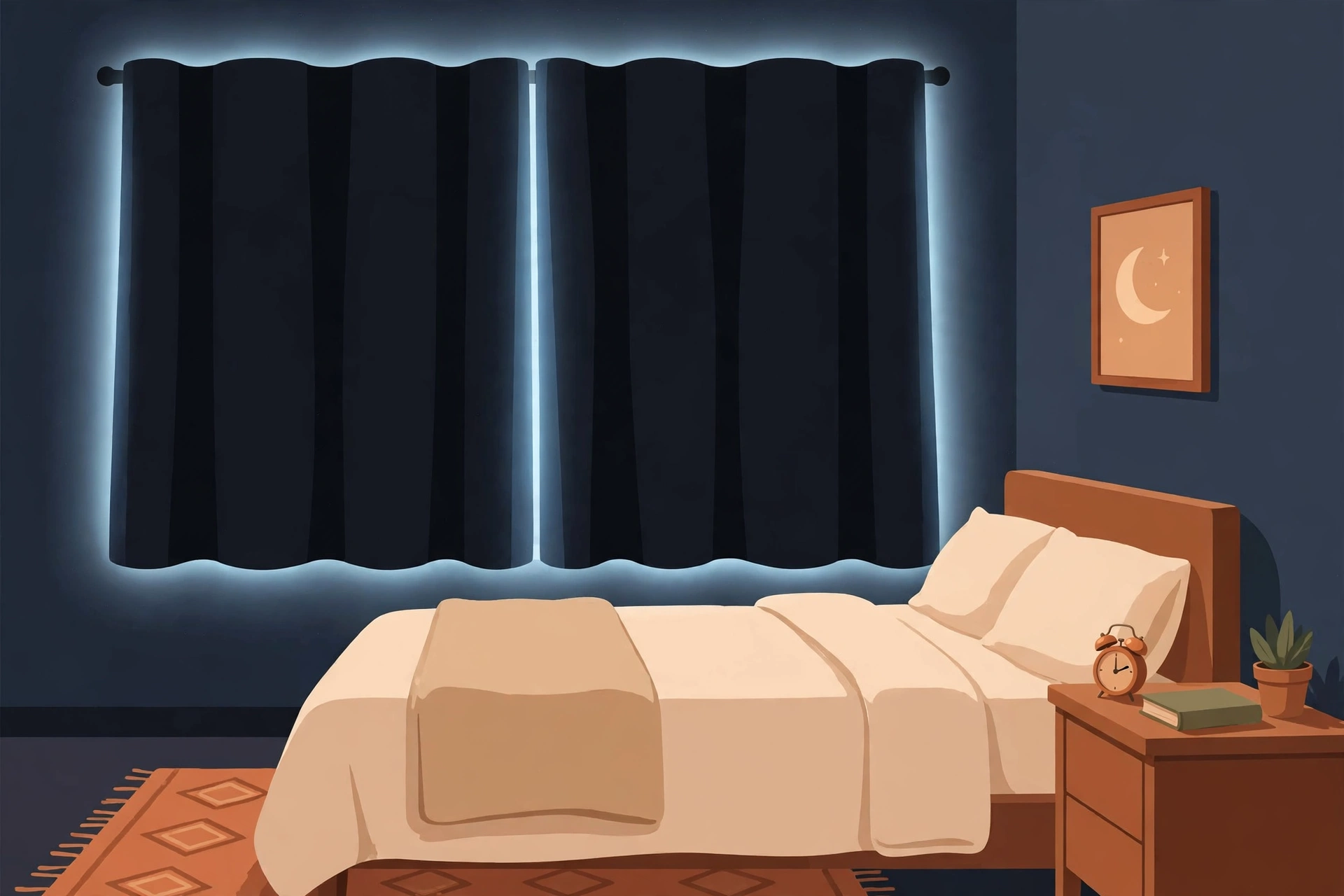
- Install blackout curtains — darkness signals melatonin release, so block street light and early-morning sun.
- Cover or remove glowing LEDs on electronics.
- Try a comfortable sleep mask — if you cannot darken the room, a mask blocks the light for a few dollars.
Your Phone Is Not Invited to Bed
Stop screens 30–60 minutes before bed. Night mode helps a little, but what you watch or read stimulates your brain more than the screen’s color does. Park the phone across the room, switch on Do Not Disturb, and let a plain alarm clock handle the waking up.
- Stop screens 30–60 minutes before bed — swap the feed for a book so your brain gets a dim-light wind-down.
- Use night mode if you must use a device, but remember that content stimulates you more than color does.
- Charge your phone outside the bedroom or across the room.
- Use Do Not Disturb overnight — silence notifications so a late buzz does not break your sleep.
- Skip doomscrolling and the news before bed — alarming headlines raise alertness; save them for daytime.
- Don’t check work email in the evening — one urgent message can undo an hour of wind-down.
- Use a simple alarm clock instead of your phone.
- Turn the clock face away from you.
Screens aside, the next big sleep saboteur is probably sitting in your mug or on your dinner plate.
Coffee, Wine and Midnight Snacks: What to Do Before Bed
Stop caffeine 8–10 hours before bed and skip alcohol for the last 3–4 hours. Caffeine blocks the pressure to sleep, and alcohol fragments sleep even when it knocks you out fast. Finish big meals two to three hours before lights-out.
- Stop caffeine 8–10 hours before bed.
- Watch for hidden caffeine in tea, chocolate, soda, energy drinks and some pain relievers.
- Keep total caffeine under about 400 mg a day.
- Consider waiting 60–90 minutes after waking for your first coffee.
- Avoid alcohol within 3–4 hours of bed, since it fragments sleep.
- Don’t use alcohol as a sleep aid — it may make you drowsy, then wakes you in the second half of the night.
- Finish large meals 2–3 hours before bed.
- If you’re hungry, have a light snack such as yogurt, oats or a banana.
- Skip very spicy or greasy food at night.
- Taper fluids in the 1–2 hours before bed to cut down on bathroom trips.
- Eat dinner at a consistent time.
- Try tart cherry juice. The evidence is modest, but it’s there.
- Eat magnesium-rich foods like nuts, seeds and leafy greens.
- Try an evening kiwi. Small studies link it to better sleep.
- Avoid nicotine near bedtime.
- Sip a caffeine-free herbal tea like chamomile.
- Don’t go to bed either stuffed or starving.
Turn Your Bedroom Into a Cave (a Cozy One)
Aim for a cool, dark, quiet room, roughly 60–67°F (15–19°C). Sources quote slightly different sweet spots, and some say 65–68°F, so treat the range as a starting line. Adjust until you stop kicking off the blankets at 3 a.m.
- Keep the room cool, around 60–67°F (15–19°C) — your body cools to fall asleep, so a cool room works with that drop, not against it.
- Make it as dark as possible — cover LEDs and gaps in curtains; even small light leaks can lighten sleep.
- Reduce noise, or use earplugs — block traffic and housemates, or mask them with steady fan noise.
- Try white, pink or brown noise — steady sound covers sudden noises; pick the tone that feels least harsh.
- Use a fan for both sound and airflow.
- Replace your mattress every 7–10 years, or sooner if it sags.
- Choose a pillow that suits your sleeping position.
- Use breathable bedding such as cotton, linen or bamboo.
- Wash sheets weekly — clean, cool bedding helps you fall asleep faster and avoids stuffiness that wakes you up.
- Layer bedding so you can adjust to temperature easily.
- Keep the bedroom tidy — a clutter-free room feels calmer and keeps work stress out of your sleep space.
- Reserve the bed for sleep and intimacy.
- Keep work materials out of the bedroom.
- Try a calming scent like lavender.
- Keep the air fresh and humidity around 40–50%.
- Move pets off the bed if they wake you.
- Try a weighted blanket if you find it calming.
Want more on the temperature question? We broke it down in our guide to the best bedroom temperature for sleep.
The Warm Bath Trick That Sounds Backwards
Take a warm bath or shower one to two hours before bed. It sounds backwards, but the cool-down afterward is what makes you drowsy. Your core temperature needs to drop for sleep to start, and a warm soak gives that drop a running start.
- Take a warm bath or shower 1–2 hours before bed. The cool-down afterward promotes sleepiness.
- Wear warm socks if your feet get cold.
- Sleep in light, breathable clothing.
- Use a cooling mattress pad if you run hot.
Move More, Sleep Deeper
Aim for about 150 minutes of moderate activity a week, ideally in the morning or afternoon. Regular exercise helps you fall asleep faster and sleep more deeply. Timing matters for hard workouts, so finish them one to two hours before bed and watch how your body responds.
- Aim for about 150 minutes of moderate activity a week.
- Exercise in the morning or afternoon when possible — daytime activity deepens sleep; hard workouts right before bed can delay it.
- Finish vigorous workouts 1–2 hours before bed, adjusting to how your body responds.
- Do gentle yoga or stretching in the evening — slow stretches release the day’s tension without raising your heart rate.
- Take a walk after dinner — gentle movement plus fading daylight helps your body wind down.
- Include strength training, which is linked to deeper sleep.
Quiet the Mental Noise Before It Gets Loud
Write it down, breathe it out, then let it go. A short brain dump and tomorrow’s to-do list get your worries out of your head and onto paper. Slow breathing and muscle relaxation then calm your body so your mind can follow.
- Do a “brain dump” in a notebook before bed.
- Write tomorrow’s to-do list so you don’t have to remember it.
- Schedule 15 minutes of “worry time” earlier in the evening.
- Write down three things you’re grateful for — a short gratitude note replaces worry lists with a calmer close to the day.
- Practice slow diaphragmatic breathing — breathe in for 4, hold for 4, out for 6, to slow your heart rate before sleep.
- Try 4-7-8 breathing: in for 4, hold for 7, out for 8.
- Do progressive muscle relaxation, tensing and releasing each muscle group.
- Try a body-scan meditation — move your attention slowly from your toes to your head, releasing tension as you go.
- Use a guided meditation or sleep story with a timer.
- Visualize a calm, detailed scene — picture a quiet beach or cabin in full detail to replace racing thoughts.
- Read a paper book in dim light — a physical book avoids screen glow and gives your eyes a single focus.
- Listen to calm music or a quiet audiobook — low, steady sound gives a restless mind something gentle to follow.
- Avoid thrillers, intense shows and heated debates late at night.
- Save difficult conversations for the daytime — hard talks before bed keep your mind rehearsing; schedule them for tomorrow.
- Set a firm work cutoff in the evening — pick a time, close the laptop, and treat after-hours work as tomorrow’s problem.
- Take up a quiet hobby like knitting or puzzles as part of your wind-down.
Still Awake? Here’s What to Do at 2 A.M.
If you’ve been awake for 20 minutes or more, get up. Do something quiet in dim light until you feel sleepy, then return to bed. Lying there frustrated teaches your brain that bed means stress, and that’s a habit you don’t want.
- If you’re awake for 20+ minutes, get up and do something quiet in dim light until sleepy.
- Stop watching the clock — clock-watching adds pressure; turn the face away and trust your alarm.
- Don’t try hard to fall asleep. Let yourself rest with your eyes open and relax.
- Look into CBT-I (cognitive behavioral therapy for insomnia), the first-line treatment for chronic insomnia.
- Try sleep restriction therapy only under professional guidance.
- Keep a sleep diary for two weeks to spot patterns.
- If you are considering melatonin, ask a doctor first — do not start it on the basis of a dose you read online.
- Ask your doctor whether any of your medications affect sleep.
- See a doctor about loud snoring, gasping or restless legs, which can signal sleep apnea or other disorders.
- Treat contributors like pain, acid reflux, allergies or anxiety.
- Be patient, and don’t obsess over sleep trackers. Fixating on the numbers can worsen sleep.
The Numbers Worth Remembering
If 101 tips feels like too many, keep these figures handy. Each one is a target you can check against, not a rule to fear. Your own numbers may land a little to either side. If you like handy numbers like these, our 101 Things Everyone Should Know collects other everyday figures worth memorizing, from money to tech to health.
| Habit | Target | Why it helps |
|---|---|---|
| Wake-up time | Same time daily, weekends too | Anchors your body clock |
| Sleep window | 7–9 hours | Covers the adult sleep need |
| Last caffeine | 8–10 hours before bed | Lets most of it clear your system |
| Last alcohol | 3–4 hours before bed | Reduces fragmented sleep |
| Last big meal | 2–3 hours before bed | Avoids discomfort and reflux |
| Bedroom temperature | 60–67°F (15–19°C) | Supports the natural temperature drop |
| Screens off | 30–60 minutes before bed | Cuts late-night stimulation |
| Nap length | 20–30 minutes, before 3 pm | Avoids grogginess and night-time hangover |
| Warm bath | 1–2 hours before bed | The cool-down cues sleepiness |
| Hard workouts end | 1–2 hours before bed | Gives your body time to settle |
Where Other Sleep Guides Get It Wrong
Many sleep guides repeat numbers without context, and the numbers don’t always agree. Here are the spots worth correcting, with the reasoning behind our version.
The caffeine cutoff. Some guides tell you to stop at 6 p.m. If you’re in bed by 10 p.m., that’s only four hours, well short of the 8–10 hours we recommend. Published estimates of caffeine’s half-life also vary, from about 3–5 hours to 5–7 hours, because genetics, medication and age all shift it. A window beats a single magic number.
Weekend sleep-ins. Our one-hour limit is a guardrail, not a law. Harvard Health notes that a 2023 National Sleep Foundation consensus statement suggests some catch-up sleep may help after a week of too little rest. Consistency is still healthier overall.
The “101 tips” search results. Search that exact phrase and you’ll mostly find book listings and sales pages, not free, usable advice. The list above is the usable version.
For the official basics, the CDC keeps a short sleep hygiene overview. If trouble sleeping has lasted months, our explainer on CBT-I for insomnia is a good next read.
You don’t have to fix everything this week. Pick three tips, run them for two weeks, and keep a simple sleep diary. Then adjust. Sleep gets better one boring habit at a time.
Frequently Asked Questions About Better Sleep
What is the single best tip for better sleep?
Wake up at the same time every day, weekends included. A fixed wake-up time anchors your body clock, which makes it easier to feel sleepy at night and wake naturally in the morning.
How many hours of sleep do I need?
Most adults do well with a protected sleep window of 7–9 hours. Needs vary by age and person, and the CDC publishes recommended sleep durations across the lifespan.
What time should I stop drinking coffee?
Stop caffeine 8–10 hours before bed. For a 10:30 p.m. bedtime, that means your last cup lands between roughly 12:30 and 2:30 p.m. Keep total intake under about 400 mg a day.
What is the best bedroom temperature for sleep?
Around 60–67°F (15–19°C) works for most people, though some sources suggest 65–68°F. Start in the range and adjust until you sleep comfortably without sweating or shivering.
Is it okay to nap during the day?
Yes, if you keep it short. Limit naps to 20–30 minutes and finish before 3 pm. If you have insomnia, try skipping naps entirely.
Does alcohol help you sleep?
No. Alcohol may make you drowsy, but it fragments sleep. Avoid it within 3–4 hours of bedtime and don’t use it as a sleep aid.
What should I do if I can’t fall asleep?
If you’re awake for 20 minutes or more, get up and do something quiet in dim light until you feel sleepy. Avoid watching the clock, and don’t try hard to force sleep.
When should I see a doctor about my sleep?
See a doctor about loud snoring, gasping or restless legs, which can signal sleep apnea or other disorders. Ongoing insomnia is also worth raising; CBT-I is the first-line treatment for chronic insomnia.

101Thing publishes practical guides and lists that help readers try new ideas, start conversations, and make everyday life a little better. Articles are researched, written, and reviewed for accuracy and usefulness before publication. Questions or corrections can be sent via the Contact page.